
Why I like Little League Baseball (and youth sports)
Cooperation is better than competition

Sexual abuse, especially childhood sexual abuse, is primarily a crime of domination. It’s not about sex, preferences or sexual gratification. It’s about domination.
Teaching our youth that domination and competition are old ways of thinking and old ways of thought, is fundamental to the survival of our species. And, that’s why I like youth sports, particularly Little League Baseball.
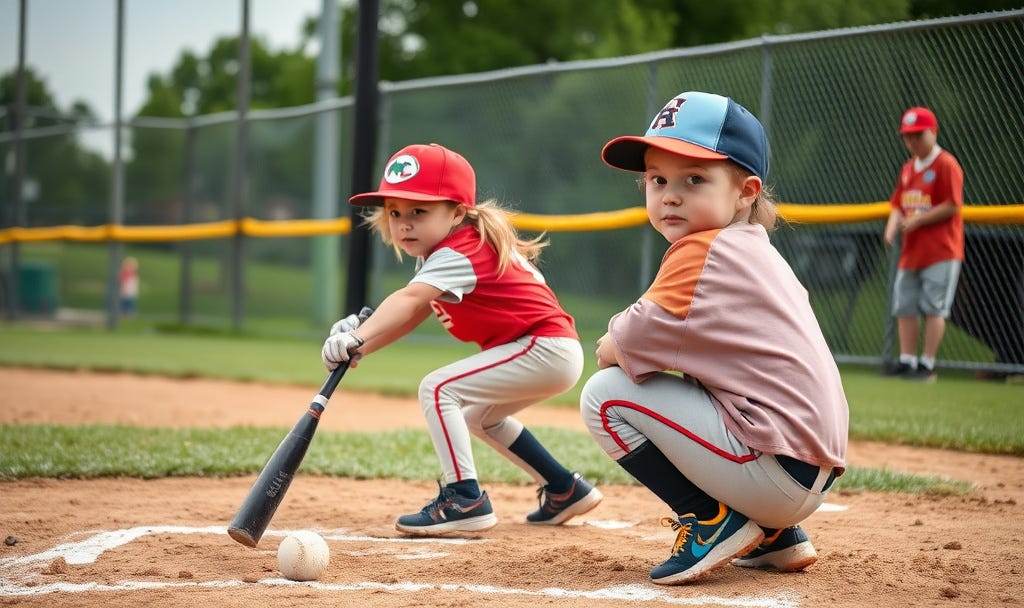
Baseball exemplifies a team sport. It’s readily apparent that one can score without the ball.1 Teamwork: get a hit in order for your teammate to score. Teamwork and cooperation are closely linked.
Conflict = Do-Over
18 months before the first release of Paperdolls, I left my parents’s lucrative2 family business. I moved to the largest firm in the west. At my new firm, which was one of he oldest around, I was the first female Executive Producer.
I attended management meetings with the owners, managers and magnetic executive producers. All men. The team welcomed me warmly. All the men, supported me, helped me out, even gave me leads. I could reach a clientele in which they couldn’t, and they knew that if I succeeded, we all benefited.
After bringing in lots of new business and hundreds of new proposals to be prepared, I learned that the other women in the firm were not supportive. They didn’t like me at all. They nicknamed me “Barbie” and a few even went out of their way to sabotage my work. I quickly learned to avoid them, give prospects my personal mobile number, and work around them. However, I was perplexed enough to ask my therapist, Karen Fisher, about it:
“It seems like many of the women resent me."
“Tell me about it.”
“Well, I have a stack of new proposals to get out. One underwriter says I got them in too early, and she has to wait to get the pricing. I waited. Now, she’s telling management that I didn’t give her enough time.”
“What did you do?”
“I went into the office last weekend. Barely slept all weekend. But, I did all the underwriting, pricing and proposals myself. I’m presenting this week, I had to get it done.”
Karen asked a few more questions. Then, calmly told me one of her stories about how little girls and little boys are socialized differently. (Please keep in mind, at this time, in Utah, little girls did not play little league baseball):
“Most men grew up playing some type of baseball. If it wasn’t organized Little League baseball, it was a school recess or even after school in the neighborhood.”
I nodded in agreement.
“What happens when there is a controversy about a play?”
They argue, and if they can’t reach a conclusion, they play a “do-over.”
Karen exclaimed, “Exactly!” Because the game must go on! A controversy doesn’t end the game.
I didn’t get her point. I said, “Of course the game goes on, a discrepancy about a call won’t stop everyone from playing. That’s why they are there.”
Karen continued, “So, we have a group of little girls playing dolls. There’s a problem. What happens?”
I didn’t know. For some reason, there were many more little boys3 in my childhood neighborhood than little girls.
Karen continued, “The girls have no playbook or even street rules. Usually, if there’s a conflict, they stop. They just quite playing. Sometimes they play something else, but frequently, they stop playing and go home.”
An a-ha for me.
“The little girls don’t learn that conflicts and do-overs and mistakes are all part of it. They don’t learn to play as a team.”
So here I am in this big organization. These women, who never learned to play as a team, look at me, the first female executive, and have no idea how to play as a team4.
Are men better at teamwork and cooperation than women?
In my experience in the corporate world, I’d say yes. But, has it changed? Little girls have been able to play little league baseball since the mid 70s.5 Has it helped women play better with one another? I hope so.
If men are better at teamwork and cooperation, why is there such a prevalence of men committing the atrocious sexual assault crimes of dominance and control?6
I don’t know. Maybe, these men never played team sports or learned to socialize as kids. Maybe they were victimized themselves. But, I sure love to have this conversation openly discussed. It’s not an easy conversation, but identifying the problem(s) will help us cure it.
Please talk about it, especially with those you trust.
Sexual abuse, especially childhood sexual abuse, is primarily a crime of domination. It’s not about sex, preferences or sexual gratification. It’s about domination.
Competition
To conclude, I would like to tell one story from my youth sports era. As a kid, I never thought that Mark Spitz’s work records would ever be beat. I had a wise coach back then, who insisted that we focus on bettering ourselves and our personal best times and scores. This coach assured us that Spitz’s records would be beaten (they were). And, it didn’t matter. It was about our own development and growth.
Later, on a long road trip we had a lengthy discussion about youth sports and ameatuer athletics. In my teenage mind, I thought it was a good training ground for pro sports, or at least a college scholarship. He laughed, then asked, “Do you know how many of these kids will get a scholarship?”7
I shook my head no.
He exclaimed: “Less than 1% “8
Children in little league sports is not about winning or gettng a college scholarship or making it in the pros. It’s so much more than that.
It’s about learning to work together, teamwork, and coroporation.
As a lofty hope, my dream is it will teach that domination is obsolete.
And, maybe, maybe if we curtail to outdated urge of domination, we will begin to alleviate childhood sexual abuse.
Many other sports, even individual sports have this lovely quality. For simplicity to this metaphor, I’m sticking to the baseball analogy.
There are some things, like freedom, that are more important than money.
Hence my experience as a child of being sexually abused with at least 2-3 other little boys. And, my assertation that little boys are sexually abused as much as little girls.
At the time, and at this business, some women did know and did help. But, many did not.
At the time, we were discussing kids’s meets, not even at the high school level. Many little leaguers never make their high school competitive team. Only 2% of high school athletes get collegiate scholarship.
Less than 1% of college athletes make it into the pros.
Ibid